2nd Project Report 2025

We arrive in Tatopani in the morning by jeep; coming from Jomsom, we have landed in a subtropical garden in less than 3 hours. The lush vegetation is actually doing me some good now, and I am enjoying the bougainvilleas. Dawa wants to go straight to the hot springs to wash off all the dirt; for me, such a Nepali public bath is not appealing at all. Tatopani means hot spring (Tato = hot, Pani = water), and there are places with this name all over Nepal. In the mountains, there are several spots where hot springs emerge from the ground; they are generally used as public baths. That means concrete basins and lots of people; Dawa tells me later that people also sit together in rooms and talk. So very much like our thermal baths after all, but I still prefer a shower at the hotel. Afterwards, I don't want to get back into my dusty and sweaty clothes; my Lowas are getting on my nerves too. It's summer here, and I want clothes that are clean and lighter. So first, I go shopping.
There is a tourist souvenir shop, including clothes that are just one step away from the tie-dyed hippie-tourist pants. But clean; there are no jeans in town. So I buy a pair of grey fabric trousers with colorful stripes on the outer seams and move on. Yes, there are T-shirts and shoes at the other end at 'Fancy Tatopani'—the name sounds promising. So I walk down the street and find said shop; a T-shirt is quickly found. There are socks too—I don't want my hiking socks anymore—and now I still need shoes. Using my hands, feet, and few words, I make it clear what I'm looking for, at which point the shop owner looks at me in utter horror and shakes his head. 'We do not have that size, not THAT big!!' Well excuse me, my feet aren't *that* gigantic! Size 40, which is still smaller than Dawa's 41; surely some kind of sneaker can be found. The owner rummages around a bit and comes back beaming with a white pair of sneakers: 'Only pair'. White. Oh well, that color won't last long, but they are wonderfully light and comfortable, and they fit. I take a look at them: NOKA sneakers. I have to smirk—so they're from China. This is where knockoffs of all major brands are made, which, through slight changes to the brand name, aren't technically copies anymore. That's why so many Nepalis walk around in Mammut, Arc'teryx, or North Face's Summit Series. On closer inspection, however, they turn out to be Arcterix, Mamut, or Norht Face. Because they use the familiar font, the typos aren't even noticeable, and so I am now the proud owner of NOKA athletic shoes. Whatever, I feel great slipping into fresh and, above all, light clothes after my shower. Dawa laughs; he finds my trousers, in particular—well, remarkable. How much did I pay for everything? I tell him the price, and he thinks everything was outrageously overpriced. 'I told you to bargain!' Yes, and I did. I paid what I thought was reasonable, and I knocked the price down by about a third, but I can't haggle over the last 100 rupees. To me, that's not even a euro, but to a Nepali, it's a whole lunch. I don't need to puff out my chest and push down to the absolute limit, and I think this way, both of us kept our dignity. When I explain this to Dawa, he looks at me warmly. Later at dinner, he tells me that maybe I was a tiny bit right after all.
From Tatopani, we continue on to Pokhara. Nepal's second-largest city, with about half a million inhabitants, is located on a fairly large lake at an altitude of about 800m and is considered the starting point for many treks, the most famous perhaps being the Annapurna Circuit. The lake with the white mountains in the background and the colorful, pointed boats is quite a famous photo motif—the city itself isn't really my thing. It's a tourist town with lots of souvenir shops, trekking agencies, bars, and nightclubs; the people are a slightly colorful mix of middle-aged trekking tourists and hippie party crowds. It's loud and not very clean; I prefer other places in Nepal. We sit in one of the countless 'German Bakeries' on the lakeshore in a tropical garden, which is quite lovely. Over cake and coffee from an espresso machine, we wait for the tourist bus back to Kathmandu. We got to Pokhara on an overland bus, backpacks strapped to the roof, jolting and swaying as usual. From here, we continue on an air-conditioned, well-cushioned bus with upholstered seats; we are on the road for almost 8 hours along the Pokhara-Kathmandu Highway. Well, whether 'highway' is an appropriate term is debatable—I've vented about the road conditions often enough—but the bus offers considerably more comfort. Even so, we are completely exhausted upon arriving in Kathmandu and take a taxi to Dawa's apartment. Sonam, his niece and the daughter of Pasang and Tashi (my hosts from Khamjing), is already expecting us. Tonight we're having momos, so we sit in the kitchen and prepare dinner. Afterwards, I go straight to bed. I'm sad that the Mustang adventure is over—Dawa made it an extraordinary experience for me—I'm looking forward to Khamjing, and I am very, very tired.
The next day, we run a few errands in the morning; among other things, I want to buy a motorcycle helmet. We're riding to Khamjing by motorbike, and I don't want to do that unprotected. In addition, Dawa needs fabric to have a prayer flag sewn—almost all you can buy nowadays are Chinese products made of synthetic fibers, but the Lama specifically asked for cotton—my duffel bag needs to be stored at the hotel until I return to Kathmandu to fly home, we need meat, and a few other things. And in between, Dawa quickly takes me to a monastery right in the middle of the city, gorgeous as always, but also completely unexpected, just around two corners. I believe I celebrated the Holi Festival around here with Frank two years ago, but I hadn't seen this monastery with its not-so-small stupa yet. For lunch, we have some leftover momos from yesterday, and then we're off again, this time (with a helmet 😎) to the Himalayan Kingdom School; the meeting with Tsewang worked out after all. I receive the usual friendly welcome from the head of our secondary school, and we spend about an hour discussing the girls. Are they doing well, where can we offer support, and how is the family doing? As we say goodbye, Tsewang invites me to dinner; it would be a pleasure for him and his wife, as today is Nepali New Year's Eve. 'Dawa, do we have time?' I'm not going there alone, so Dawa is automatically included. 'Yes, of course we do.' Dawa loves eating and eats often, so he's delighted. What kind of food would I prefer: Nepali, Korean, or maybe Chinese? I leave the choice to Tsewang and look forward to seeing what we'll have tonight. Later in the afternoon, Dawa receives the address and clicks his tongue. 'This is realy expensive place, Simone, he really means well!' Oh great, we're going out for an expensive dinner, and I'm wearing dirty sneakers, jeans, a T-shirt, and a softshell jacket caked in dirt. Everything else is in my duffel bag at the hotel. So in the evening, we set out again and pull up in front of an upscale mall across from the Royal Palace; I've been here before. At the very top is a restaurant, 'Himalayan Coffee', so it seems there will be Nepali food—great. Upon arriving, we are welcomed by Tsewang in dress pants and a shirt, and his wife in an ironed blouse with lovely gold jewelry. I shove my sneakers under the seat—they're no longer white—and take off everything down to my T-shirt, which is fresh and somewhat presentable. And then the menu arrives, and I really hope my disappointment isn't too obvious. They have burgers, pasta, and pizza. My hosts and Dawa think it's fantastic: 'We thought you might like some European food, you must have had so much Dal Bhat by now!' 'Very thoughtful, yes, of course, what a nice idea,' I lie. The evening turns out to be very pleasant anyway; Tsewang talks about his travels and family, I talk about Mustang and my daughter, and Tsewang speaks very highly of NepalAid's approach of working in a small area with a project that truly helps people. 'It is good the children are in the mountains first. They need to grow roots before the can spread their wings!' I like Tsewang very much; we often share similar perspectives and approaches, and the evening turns out to be really lovely. Despite the chicken burger.
And then it's finally time for Khamjing! 'I have surprise for you at home!' Aha, what kind? I want to have a meeting with Dawa and Pramod, our Childhome manager and Dawa's deputy; besides that, I'd like to meet the mayor of Syaphru Bensi, nothing more. My kids are still on break, and that's where they should stay; it's important that they spend as much time as possible with their families. And so we head towards the mountains on the motorbike again, with my trekking backpack on my back containing a change of clothes for four days. After a few hours, it gets pretty heavy, my knees hurt, and my back could really use a break, so I'm glad when we stop for our lunch break in Trishuli, about halfway there. Dal Bhat, and no, I don't get tired of it and am happy once again to enjoy a delicious meal. In the early afternoon, we reach Dhunche—now I know my way around again! When we arrive in Syaphru, we pass by the house of our driver, Baisano, who happens to be standing outside the door waving; I wave back. Nothing has changed, how wonderful—or has it?! At the northern end of town, a large, golden Buddha statue now sits enthroned—that's new! Then we turn off the highway and head up the mountain, around the final bend, and we're finally there, in Khamjing; I'm so happy. Pasang and Tashi welcome me warmly, as expected, and immediately bring me a milk tea: 'You like that, right?' Yes, I love drinking it and am a little touched that they remembered. Dawa comes over: 'You stay here, I come at 5pm. Have a shower and relax.' Um—okay. And Kami, Dawa's wife? And Pramod? Can I briefly say hello? No, I should shower. Fine, then I'll shower.
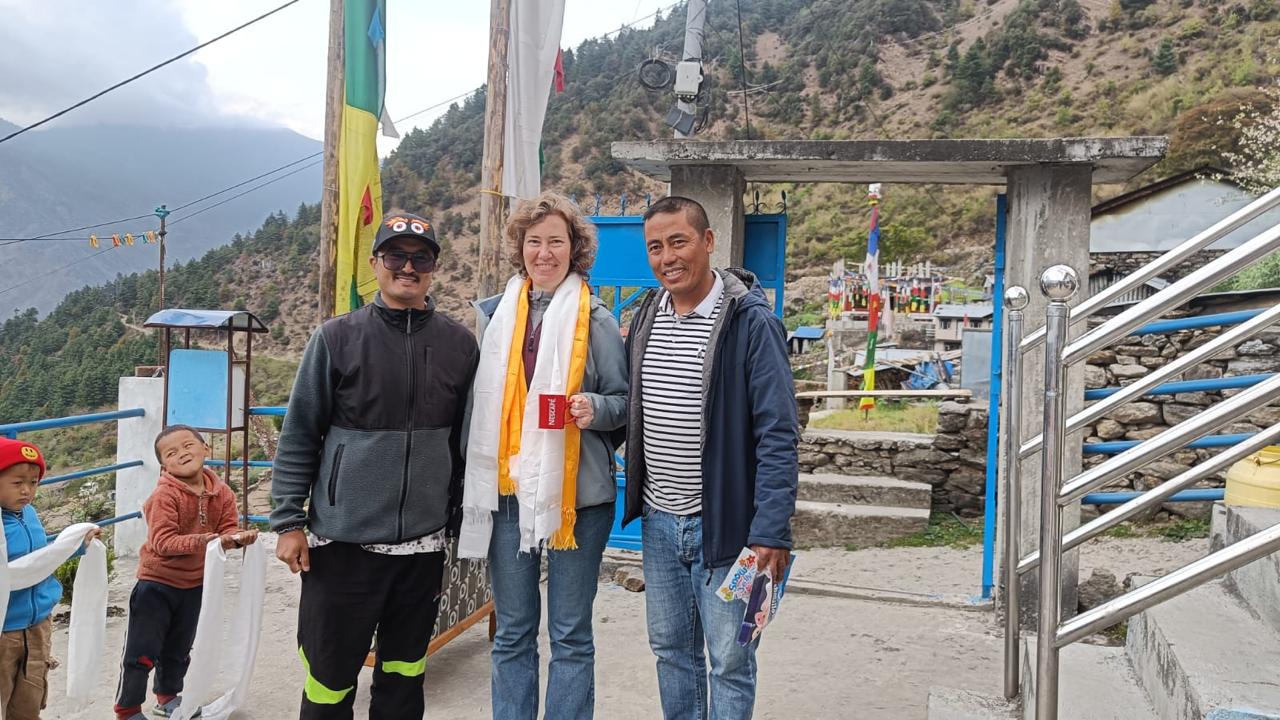
At 5 o'clock, Dawa comes to pick me up, grinning. We walk down the stairs, around the corner—and there I see all my children! I'm almost in tears: 'But they are on holidays! And look, all the big girls as well!' 'I thought you are happy when children are here, one night we celebrate Nepali New Year all togehter.' Yes, the surprise was more than a success; I am completely touched. For one day, Dawa brought the children from their families; first, I am greeted in the traditional Nepali way—with scarves and very formally—then the children dance for me. I take it all in and wait patiently, and then tea is served. Now I sit down on the bench with the children and can talk with them; it doesn't take long before I have the first ones in my arms and everything is just like always. We have a wonderful evening with Dal Bhat (yes!) and games, conversations, and a Bollywood movie, then I go to sleep. The next morning, we start preparing momos. 6 kg of meat, a giant mound of dough—there are 22 of us in total, and we spend a long time preparing them. In between, I talk with my children, play with them, and hug them. I give praise and gentle reminders based on what I've heard over the year, and I'm so glad the children still feel so close to me, even after not seeing me for a whole year. We all really enjoy the momos, and then the children head out again. Baisano, our driver, takes them down to Syaphru, where their parents will pick them up. The goodbye is very heartfelt; first we stand as a 'cluster' on the terrace again, and then I hug each child individually once more. It's so wonderful to see how they grow, get older, and also how I can converse with them more and more as they progress in school. I hold back a tear or two as we say goodbye and am grateful for my sunglasses once everyone is gone; only Kami isn't fooled. She laughs at me and says something in Nepali; Dawa and Pramod shake their heads vigorously. 'Kami says you are sad, crying?' 'A bit, perhaps...' Complete bewilderment from the two guys—didn't we just have a great time?! Yes, well, I won't see the children again for another year; I miss them already, but the surprise was so fantastic, I am very, very grateful! And happy.
Next comes the meeting with Dawa and Pramod; I want to hear how the past year went and exchange thoughts on the year ahead. Every now and then, I explain the German perspective, justify certain requirements, and listen to the Nepali side—where can we find common ground? I'm excited about their ideas and try to hit the brakes where they might be overshooting the mark a bit, just as they do with me. 'We are in Nepal Simone, how do you expect us to do that?' Hm, true—some things are simply different than in Germany. I usually really enjoy these meetings; I learn an incredible amount about different viewpoints, question my own conditioning, and am pleased every time we find common ground. And we usually do—in the worst case, simply because Dawa does me a favor and begrudgingly accepts adapting to our way.
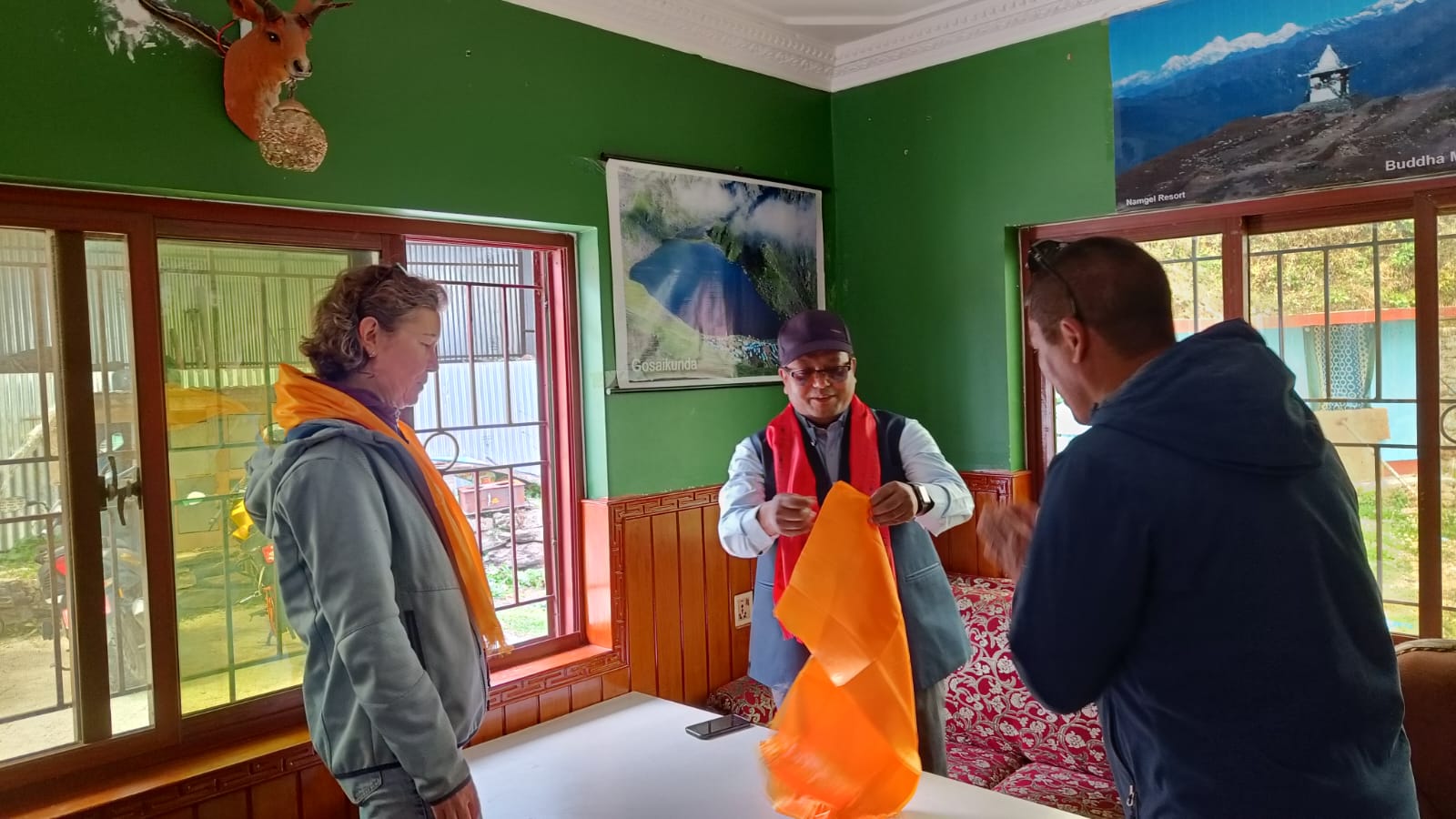
Finally, I meet the mayor for lunch—you guessed it, Dal Bhat—as I want to ask him for some support. Yes, of course, whatever I need, he will try to make possible. Unfortunately, he can't help us financially; his budget is completely exhausted for the next 2–3 years, but he is delighted that we are offering such dedicated support in his municipality. Nevertheless, he gives me a few tips that will help us move forward, and here, too, we say goodbye with a 'See you next year'. And just like that, my stay in Khamjing is already over; the day after tomorrow is my flight back to Frankfurt. I'm actually not ready at all to say goodbye; I felt incredibly comfortable here once again. But my family in Germany is waiting, and Easter is just around the corner. So I hop on the motorbike behind Dawa, and we head toward Kathmandu. I enjoy the ride as always; starting from Kalikasthan, it gets warm—we're out of the mountains. We take a few breaks for tea and the restroom, for lunch, and simply to rest; the last few days have been quite demanding. Finally, we round one last bend and catch our first glimpse of Kathmandu, eventually arriving at the hotel. I get organized for the next day, and after a very early breakfast, Dawa picks me up. At the airport, I hand him my motorcycle helmet—'For next year'—and say goodbye. Through several conversations, I was able to move various projects forward a bit, I hope, but above all, I believe I was able to strengthen the connection between NepalAid and our project partners. It is always good and right to enter into dialogue, exchange perspectives, and build an understanding of one another in order to find common ground together. So I board the plane feeling quite satisfied. Hearing the announcement 'Due to an expected high number of departures, we will be delayed by 1 hour' makes me smirk—flight schedules are made in advance; those departures couldn't have been entirely 'unexpected'. Nepali planning ❤️