Travel Report Mustang 2025 - Part 3

So in the morning we pack our things early and start walking. When you drive through Mustang, it already looks very barren. When you walk through it, the whole thing takes on another dimension. Right behind Lo Manthang we are back in the middle of nowhere, and there's no water either. We each haul our bottles with us; it annoys me, but the necessity of it is obvious. When we walk through wind-sheltered depressions and the sun is shining, it's really warm and I start to sweat. When we come around a rock and—especially from noon onwards—the wind hits us, it suddenly turns freezing cold. The wind brings the chill of the high surrounding mountains with it, and I'm busy the entire time taking off a jacket, putting it back on, off, on....
At first we still walk over relatively gentle undulations, around rocks, sometimes up, sometimes down—Nepali Flat, they call it—and I'm reasonably satisfied with my performance. Dawa packed a few apples from Mustang, and we also have plenty of Snickers with us; that keeps us going until the early afternoon. Then we can already see our first overnight stop down by the river, Dhee. 'That's where we are going' I look down. And I feel like when you're skiing, standing at the very top of a black run and reality hits you when you look down. 'You mean - down there? Where is the trail?' 'We are going there, look,' says Dawa, pointing to the long scree slope between 2 rock needles, which has an incline of at least 45%. 'No, I mean - where are WE going??' Dawa looks friendly, which means he has no idea what to do with my question. And here comes reality: I will somehow have to get down there. Luckily, my mother doesn't know what I'm currently facing here! 'Dawa, let's get down the nepali way, slowly, slowly, ok?' I really have a mediocre feeling about this descent, but I have to get down somehow. So we begin the descent. After all, I've lit various butter lamps that will surely help me arrive at the bottom in one piece. And if those weren't enough, I've been told often enough here that I have excellent karma. So nothing can really happen to me. Still, the descent takes almost an hour; we keep taking breaks because I just can't go on anymore. On the one hand, the slope over this long stretch is really no joke, but the ground beneath my feet gives me even more trouble. The scree turns out to be a mix of friendly, round pebbles and a sand-dust mixture; either the stones roll away beneath your feet, or you sink so deeply into the dust-sand that you can't find any footing either. In addition, I'm balancing my backpack on my back the entire time and trying very hard to cushion my falls. In between, I'm convinced that I should have lit 7 butter lamps after all. But Dawa somehow gets me down, and I am overjoyed when we finally arrive at our lodge. It really is very basic: the toilet is across the courtyard with a dirt floor, and there is no shower. I don't care; I won't take another single step today. I'm delighted with the soup that the landlady immediately offers us, a Thukpa, Tibetan noodle soup. We sit in the kitchen, which is actually always where I prefer to eat; I rarely go into the dining rooms found in almost every lodge. I always enjoy watching the landlady prepare the food, and Dawa is always content when he can chat there with other guides or the hosts. After the Thukpa, there is a milk tea; I let myself be entertained by the hustle and bustle around me and feel very content. 'Tomorrow is easier, only 3 hours, then we are in Yara. We leave our luggage and go to Cave Monastry after lunch' Yes, that sounds good, that's what we'll do then. The next day, we initially walk a good stretch through the riverbed; it's nice and flat and I don't slow us down too much, so we make good progress. Naturally, it goes uphill again at some point; we actually arrive in Yara around 10 a.m. and check into a lodge with an en-suite 'bathroom' and hot shower. First, I want to take a shower.
The 'bathroom' is a concrete room with an open window; on the wall there is a shower head and a sink, and at the back is a step spanning the entire width, with an Asian squat toilet set into the raised platform. The obligatory bucket of water for flushing stands in the back corner. Clean looks different; I look around, trying to find the least dirty spot to put my clothes down. Relatively unsuccessfully. But whatever, I want to wash off the perpetual dust, especially out of my hair. Here, just a few hours after I wash it, my hair feels dull and matted again from the strong wind and the dust that's everywhere in the air. When I touch my hair, my hands are immediately dirty again, and during the first shampooing, the lather is dark brown. So, a shower is due, no matter what it looks like here. Still better than yesterday! The 'hot' water is lukewarm; afterwards I am completely chilled to the bone, but clean, which is great. And the courtyard of our lodge catches the sun and keeps out the wind, so that over pancakes with peanut butter I slowly warm up again and my hair can dry.
Then we set off again; we want to visit a cave monastery, the walk there takes maybe 1.5 hours. Along the way, we encounter various animals again, which Dawa usually spots before me and scares away. Jerk. Arriving at the monastery, stairs adorned with colorful prayer flags await us; at the top sits the red-painted monastery. I learned that religious buildings are painted in terracotta red, while administrative and residential buildings are white, which is why, for example, the Potala in Lhasa is two-toned. A nun is waiting for us at the top and first offers us some tea. Then we enter the cave monastery; the old stupa is about 800 years old and truly beautiful. The elevated location adds to the solemn atmosphere. We light butter lamps again and make our way back; today I'm supposed to rest, starting tomorrow it will get strenuous. 'I will go and get horse now'. Yes, please. I'm dreading the next two days a little, and I'm overjoyed to have four-legged support. Even if I feel totally ridiculous doing it. At dinner, Dawa is thrilled; he found a horse and the horseman will come with us almost until the end. Reassured, I fall asleep and also look forward to tomorrow a little; it has been a very long time since I last rode a horse.
The 'horse' turns out to be a pony the next morning, and at first I doubt whether it can carry me at all. But I know that the mountain horses here carry about 80-100kg when transporting goods, and I certainly don't weigh that much. Even though Dawa tells me over and over again that 60kg can't possibly be true in this lifetime, I look like 'much more'. 🤨
We walk all day; in the end it will be 24km. We start in Yara at an altitude of 3500m, and in the evening we finish at about the same level; in between it went up, then down—and up again. To be honest, without the horse I wouldn't have made it. At noon we stop at a house—I'd compare it to a caravanserai in the Arab world—we get Dal Bhat and plenty of water, but otherwise we don't see another house all day. And no people either. There are three of us, plus the horse, and that's it. There are no birds here either. And since you don't hear any splashing water either, during the breaks or even when walking over the dust-sand, you might hear nothing at all. Absolutely nothing. In the morning, not even the wind. I tell Dawa that something like this has never happened to me in my life, hearing absolutely nothing. In Europe, you always hear something, and on other continents, I've never been in a situation where I heard nothing for hours either. Visually, too, nothing distracts from one's own self, and so you actually enter a state of drawing your entertainment from within. When I walk, I can't talk, and when I ride, I don't like to talk; I feel a bit embarrassed to be carried along completely relaxed time and again while Dawa and the old horseman walk kilometer after kilometer. I think a lot about the past year, about the coming days, about myself and the world in general; I have plenty to keep me occupied. The men always decide when I walk and when I ride; it's rare that I have so little autonomy, but here I place myself entirely into their experienced hands. And so it happens that on the first afternoon I walk the last couple of kilometers over a flat stretch; the horse carries my backpack, and I stroll far ahead, since I'm rested after all. Before reaching our next night's quarters, the path drops steeply again over scree between the rock needles. Since I don't have to carry my backpack, I have a bit more balance, but I still cross myself three times when we reach the bottom. In our lodge, there are 2 French guests with a guide and porter; they arrived slightly before us and are sitting in the dining room. I sit in the kitchen with the Nepalis, a cat comes and sits next to me, and the evening turns out quite cozy.
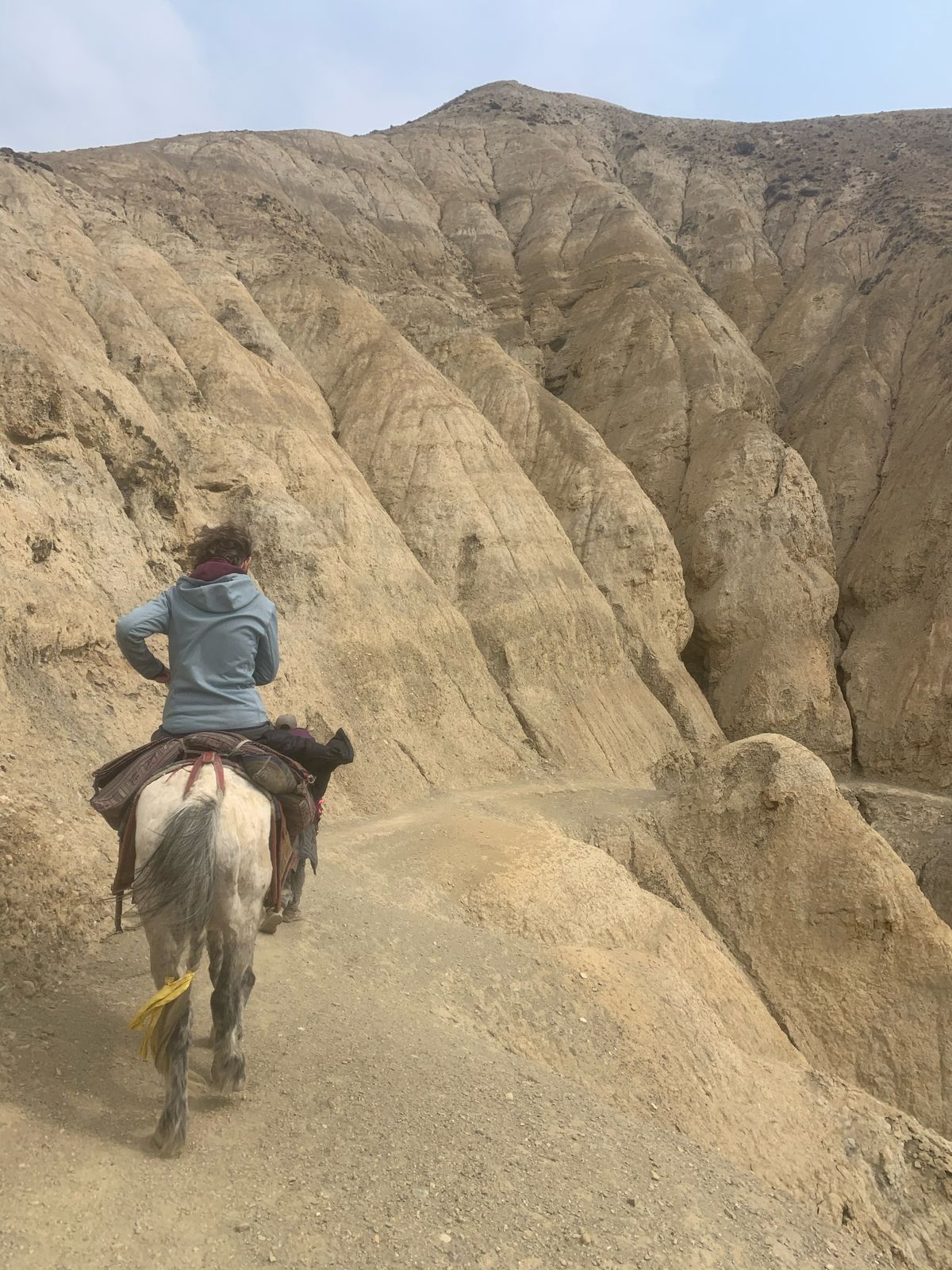
The next morning we start very early, have a packed lunch prepared, and off we go. First across a very long suspension bridge for Dawa and me, while the horse and its owner walk through the riverbed. Then along Nepali Flat (constantly up and down) slowly ascending up to the Paa Pass at an altitude of 4183m. You get there via very steep ascents and also repeated descents, and above all via very narrow paths along rock faces. In a few places, the path is 15cm, maybe 20cm wide, and I try very hard not to look down. I'm sitting on the horse, which after all has to coordinate 4 legs, and I think again of the many butter lamps Dawa and I have lit over the past few days. I really am mildly concerned; if the horse stumbles now, there's nothing for the first few hundred meters of vertical drop to break my fall. But the horse is experienced and alive, so it knows what it's doing, the horseman doesn't want to lose his horse, and I already pointed out to Dawa earlier that he'd be in immense trouble if anything happened to me. He knows that too. So everything will turn out fine, as long as I don't look down. Similar paths will appear repeatedly throughout this day, and I am grateful that I'm not afraid of heights! Thus we all make it up to the Paa Pass; here we also see the French guests from our accommodation for the last time, who had already set off when I had just appeared for breakfast. They are already quite slow and have barely covered half the distance to the next village; I feel a bit self-conscious again about having support, but also overjoyed to have it!
From the Paa Pass, it goes downhill, Nepali flat. A little past the pass we take a rest and eat a bite; without looking at me, Dawa hands me an apple. For the horse. He thinks it's quite a waste; I think it has earned the apple! For the past two days there were quite a few arguments about this, that the horse should just eat the grass. There is no grass here, Dawa, nowhere! 'What do you think the horses are living from when there is no Simone around?? Apples are for us!' 'Fine, then no Snickers for you either, there is bread in the bag!' I'm walking on rather thin ice; I'm carrying neither apples nor Snickers, but that doesn't cross my mind at that moment. Eventually, it probably gets too silly for Dawa and he relents; from then on, the horse gets an apple at every rest stop we take—as long as we are eating too. If we don't eat, the horse gets nothing either. Fair enough.
After the break, the horseman says goodbye; from now on I have to get through on my own. We walk. And walk. And walk. When I ask how much further it is, Dawa points upward, along the trail, and around the next rocky outcrop. Ah yes, okay, I can manage that! Around the rocky outcrop the trail continues, around another outcrop. And so on. Eventually, I ask how many more times we have to go 'up and round'—the answer is a hand gesture indicating 'up and around'. On the inside, I'm crying. Eventually, we are standing above Chhuksang, the border between Lower and Upper Mustang; this is the police checkpoint where my permit was checked after the days in Kagbeni. I'm happy, I'm utterly exhausted, I even shared the last Mars bar with Dawa, which I actually don't like at all. But: ABOVE Chhuksang, it goes down what feels like a vertical drop for a long distance; I've walked a ton that day and notice that my legs are slowly reaching their limit. I slip and stumble along the path, having to concentrate intensely at several very narrow sections. At some point, Dawa silently takes my backpack from me and I have to give in; I simply can't manage the descent with the pack anymore. When we arrive down at the checkpoint, a police officer hands me a chair and I don't move anymore. Not an inch.
Dawa checks me out of Upper Mustang. What a trip, I am completely overwhelmed. The beauty, the barrenness, the colors and shapes, and the culture of Mustang completely captivated me; it is one of the most beautiful journeys, if not the most beautiful, I have ever taken in my life. Anyone looking for lush green is completely out of place here. But for me it was the fulfillment of a dream, as wonderful as I truly hadn't expected.
Dawa arranges a ride for us in a jeep to Jomsom, where we will spend the night before continuing the next day via Tatopani and Pokhara to Kathmandu and finally to Khamjing.
Before we get into the jeep, I express my gratitude. 'You have no idea what this trip meant to me, thank you so much, thanks for everything!' 'If you're happy, I am happy!'